Pioneers of Plastic Surgery

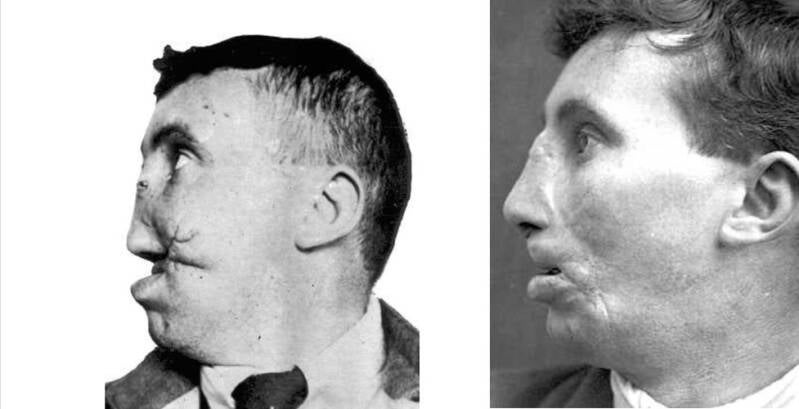
During WWI, 60,500 British soldiers were wounded in the face or eyes, and injuries to the nose and jaw were prevalent because their helmets did not protect the lower part of the face. Here are the men responsible for creating their prosthetics. 

Harold Gillies

Father of Plastic Surgery

William Kelsey Fry

Surgeon of maxillofacial restoration. 

Francis D. Wood

Sculptor

Henry Tonks

Official War Artist

Fredrick Coates

Facial Architect

T. P. Kilner

Surgical Specialist

More about the Pioneers

Harold Gillies

Gillies was widely regarded as the modern father of plastic surgery. He began work at Queen's Hospital in Sidcup, which was the first hospital in Britain dedicated to facial reconstructive surgery.

Gillies strongly advocated for his patients and for patient-centred teams, which only became standard practice in 1960s. He used pedicled and tubed flaps to restore facial function. Gillies recognised the importance of improving the appearance and aesthetics of plastic surgery, a huge change from the functionality aspect of surgery pre-war. He made several records of pre and post-reconstructive faces, and his inventions such as the Gillies tissue forceps and the Gillies needle holders are still used to this day.

William Kelsey Fry

Fry worked with Harold Gillies during WWI. He specialised in treatments for patients with cleft palettes and facial deformities. He was credited for designing inventive dental prostheses that returned masticatory function to patients with jaw injuries. Fry worked with soft tissue whilst Gillies worked with hard tissue.

Francis D. Wood

Wood was a sculptor who produced the idea of portrait masks. With these, he aimed to recreate the patient’s original appearance from surviving features and pre-injury photographs. The masks were uncomfortable, but valuable for reconstruction.                                                 He worked with blind and facially disfigured soldiers.

Henry Tonks

Tonks was appointed during WWI as a professor of art and official war artist, since he had been a surgeon and teacher for 20 years before the out break of the war. He sketched soldiers who had sustained facial gunshot and shrapnel wounds. His background in surgery made the drawings anatomically accurate. Four of his paintings appeared in Harold Gillies’ book, Plastic Surgery of the Face, (although, only in black and white)

Fredrick Coates

Known as a ‘facial architect, Coates also worked at Queen’s Sidcup with Gillies. He created plaster cast limbs and faces that helped to execute surgical reconstruction. His plaster reconstructions helped to give an accurate idea of the amount of flesh needed in a way that photographs could not.

T.P Kilner

Kilner worked as a surgical specialist in no. 4 General Hospital. He became an assistant to Harold Gillies postwar, to continue reconstruction victims of trench warfare. Kilner was one of only two plastic surgeons in Britain by 1921. He developed many instruments such as the needle holder and malar retractor. His area of expertise was cleft lip and palate surgery.

Tubed Pedicle Flap Procedure

How it Worked

Gillies tubed pedicle flap procedure was highly significant in terms of wartime development of plastic surgery. The technique originated in India around 600 BC and was described by a surgeon named Susruta as ‘the process of affixing an artificial nose… a catch of living flesh should be sliced from the region of the cheek.’

During the procedure, the patient is operated on in an upright position to reduce the risk of blood loss, and a handkerchief which acts as a tourniquet is tied around the patient’s neck to constrict their forehead veins, so they can be used within the flap. Gillies was the first surgeon to perform this surgery in Britain. 

Image: Tubed Pedicle Flap performed by Russian surgeon Filatov in 1917.

The Advantages:

Gillies listed some advantages of the tubed pedicle flap over other kinds of skin flaps:

-    An absence of infection and scarring.

-    Flexibility of the tube since it can be twisted and kinked which the non-tubed flap can not.

-    The patient is more comfortable since the length and the flexibility of the tubed pedicle flap allows for more movement in the face. Since all the wounds are closed, dressing needed is minimum.


Images of facial reconstruction

The Museum Exhibition John Doe, is an example of what facial reconstruction would have looked like in WWI. 

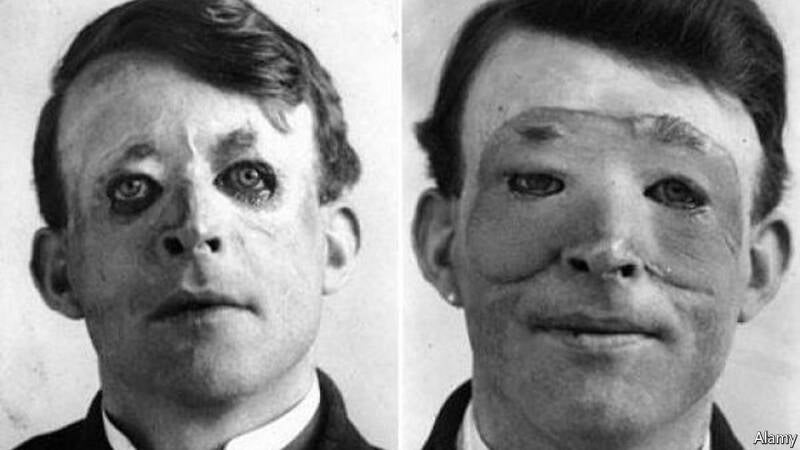
The facial prosthetics were made based on sketches and mock ups. These were difficult to replicate since they had to account for missing cartilage and tissue.

After the sketches were completed, a plaster cast would be taken of the patient’s face. The prosthetics were made of a thin copper sheet and painted to match the skin colour of the patient.  

Facial prosthetics were often accompanied by fake glasses, or a fake moustache attached with a hook, especially if it was a nose which needed rebuilding. 

Contemporary historians debate that the inherent functions of the masks was to hide. and therefore, instead of restoring the identity of the wearer, the mask lacked human emotion and reminded the viewer of the horrors of war. 


Here are some examples of facially disfigured veterans before and after plastic surgery:

The Art of Prosthetics

A lot of work went in to creating prosthetics for wounded soldiers. The mask had to be fitted to the individual. Unlike uncomplicated facial deformities, treating wounded soldiers was much harder since their wounds were almost always infected, and there were no antibiotics. More than 12% of wounded British expeditionary force soldiers developed gangrene in 1914.

Read more »